The encounter with the unblindfolded man on the river
Bird BoxThe encounter with the unblindfolded man on the river is a confrontation in which Malorie’s refusal to see becomes a condition of survival. When an approaching boat draws level with her rowboat and stops, its occupant presents himself as an ordinary, unafraid traveler; then he uses that claim to pressure Malorie and the children to uncover their eyes. His attempt to take control ends with the boats separating, but not before the scene makes the river’s promise of escape inseparable from the danger of meeting another person.
Approach on the River
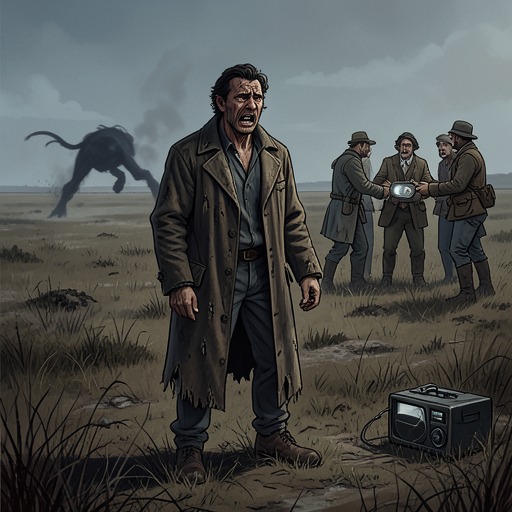
The encounter begins with sound rather than sight. The children have been quiet, and a bird calls above the water when the Boy cries out; beyond the current, Malorie hears an engine and recognizes another boat approaching. She does not welcome the prospect of company. On this river, another human being is not automatically reassurance: the boat’s presence raises the possibility that its occupant can see, and that approaching contact may carry danger.
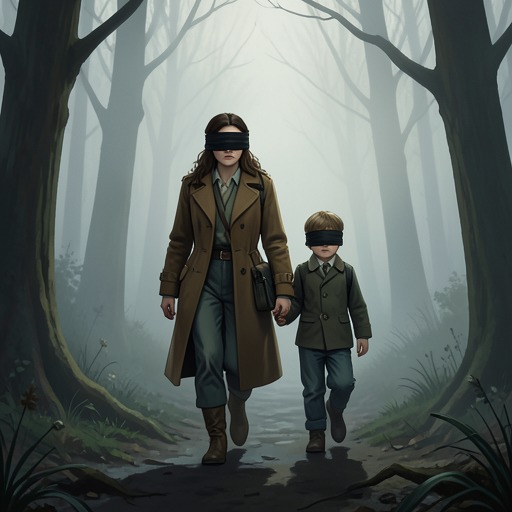
As the engine draws close, Malorie knows the other boat is beside them because it stops level with theirs instead of passing. She warns the children not to remove their blindfolds. The engine cuts out, she smells gasoline, and footsteps cross the unseen deck. The scene supplies the stranger’s position and movement through changes in sound and proximity, while Malorie remains unable to verify what he looks like or what he is doing.
The Stranger’s Claim and Pressure
The man calls out that it is safe to uncover their eyes, describing himself as an ordinary man and insisting that they are alone. Malorie does not accept reassurance as proof. She asks how he knows there is nothing with them, and he answers that he has kept his eyes open throughout the day’s trip and the previous day as well. His claimed freedom to look is precisely what makes him dangerous to her: his certainty rests on a rule she knows cannot be trusted.
Malorie tells him that looking is not safe. The exchange hardens into coercion when he says he ought to remove the family’s blindfolds himself. He frames them as two adults and two children meeting on a river, calls himself the only one with the nerve to look outside, and argues that their precautions merely prolong their fear. His language recasts protection as irrational confinement and attempts to make Malorie’s care for the children seem like the real threat.
He then says he has seen one of the creatures. Instead of reassuring Malorie, the claim intensifies the danger: she cannot know when he saw it, what has happened to him since, or whether his behavior signals that madness is taking hold. She grabs the Boy by the back of his shirt and pulls him against her; he hits the metal bottom of the boat and yelps. The man laughs. The gesture turns the discussion into an immediate contest over the children’s safety.
Escape and Immediate Aftermath
Malorie tries to push away from the bank, but her rowboat bangs against the man’s boat. For a moment, the collision leaves her trapped beside him, with the possibility that he could force their eyes open. She yells for him to leave them, and water splashes into the boat during her struggle. The Girl shrieks. Malorie continues to reason through the danger: she considers asking how long ago he saw the creature, and whether the madness might develop more slowly in him, but she cannot make his condition certain or wait safely for an answer.
The rowboat finally comes free. The man shouts for Malorie to open her eyes, then turns his appeal toward the children, calling their mother mad and telling them to remove their blindfolds. Malorie paddles furiously and tells them not to listen. Behind her, the man’s voice breaks into a howl and gargling sound; the narrative imagines that he may strangle himself on a rope rail or fall into his boat’s spinning propeller, but neither outcome is confirmed. The immediate fact is that the family gets away while his cries recede.
After the boat has traveled another forty yards and the engine is almost out of earshot, Malorie reaches forward and touches the Boy’s shoulder, then reaches back to find and squeeze the Girl’s hand. She lets go of both children and takes up the paddles again. Their brief contact marks the end of the confrontation, not the end of the journey: Malorie must resume the work of moving forward without sight.
Significance in the Escape
The scene reverses the expectation that encountering another person will mean help. The stranger offers an apparent release from the strain of blindfolded travel, but his offer depends on abandoning the safeguard Malorie trusts. When persuasion fails, he threatens to remove the blindfolds himself and recruits the children against their mother. Human contact becomes an extension of the danger rather than a refuge from it.
The river itself remains both route and exposure. Malorie is trying to travel away from the house, but the open water leaves her vulnerable to an approaching boat whose position she can hear without seeing. The encounter makes her practical knowledge—listen, keep the children covered, paddle free—more reliable than the stranger’s confident claims. It also establishes that the threat of the creatures reaches the family through other people: the man’s account that he has seen one cannot be verified, while his coercive behavior is audible and immediate.
The episode’s tension is built from the gap between what Malorie hears and what she can know. An engine draws near; it stops; footsteps move; a voice gives assurances; a collision proves that the boats are entangled. Without sight, every sound has to be interpreted under pressure, and there is no neutral way to test the stranger’s story. The family’s escape does not resolve what happened to him or whether he was already affected. It leaves Malorie with the only decision the scene permits her to make: keep the children blindfolded and keep rowing.